Meeting European Acoustic Standards Under EN 17823

Nils Magne Dahle
CEO
When foot traffic, running, or dropped objects impact a concrete staircase, they generate structural vibrations. If the stairs and landings are rigidly connected to the walls, these oscillations transmit directly into the building's structure. The result is distracting impact sound that travels throughout the entire building.

To ensure a comfortable living and working environment, building regulations across Europe enforce strict limits on maximum allowable impact sound levels. The lower the decibel (dB) rating measured inside an adjacent apartment, the better the sound insulation.
New, independent laboratory testing confirms that Invisible Connections’ unique staircase connectors do not just meet these requirements - they deliver results with a safety margin that sets a new industry standard.
Proven Test Results
In February 2026, the recognized German testing institute STEP GmbH (Schalltechnisches Entwicklungs- und Prüfinstitut) conducted comprehensive acoustic measurements on Invisible Connections' products.
The testing was performed in strict accordance with EN 17823. This is the new European standard (approved in May 2024) that defines the most stringent and precise laboratory testing procedures for measuring impact sound insulation in staircases and stair-isolating components.
The data recorded at the Winnenden testing facility proves exceptionally strong when comparing the measured impact sound pressure levels against the official Class C requirements in Europe.

From the acoustic laboratory measurements of Invisible Connections' products, conducted by the German testing institute STEP GmbH in strict accordance with the new European standard EN 17823.

From the acoustic laboratory measurements of Invisible Connections' products, conducted by the German testing institute STEP GmbH in strict accordance with the new European standard EN 17823.
Elastomer vs. Solid Rubber
The remarkably low sound levels achieved by Invisible Connections are the result of advanced material technology and Norwegian engineering, not luck. Built into the TSS and RVK units is a specially developed elastomer dampening material.
While many alternative solutions on the market rely on basic neoprene or solid rubber for sound dampening, these materials exhibit distinct weaknesses over time:
- Solid Rubber and Neoprene Creep and Harden: Under continuous mechanical load from heavy concrete components, traditional rubber deforms, flattens, and loses its elasticity over time. As the rubber hardens, it creates acoustic bridges that allow sound waves to pass through.
- IC Elastomer Retains Its Elasticity: The high-tech elastomer used in IC products is engineered to withstand extreme loads without experiencing structural creep over time. The pads retain their original shape, provide flawless deflection, and maintain their dampening properties throughout the entire lifecycle of the building.
IC Elastomer is known for its high elasticity and its ability to recover its original shape after extension and compression.
Why Profiling and Bearing Area Matter
To achieve effective impact sound reduction, a dampening material must have physical space to expand when compressed. If a solid rubber block is completely encased in concrete, it has no room to expand, which drastically reduces its sound-dampening capabilities.
Invisible Connections solves this challenge through two engineering features:
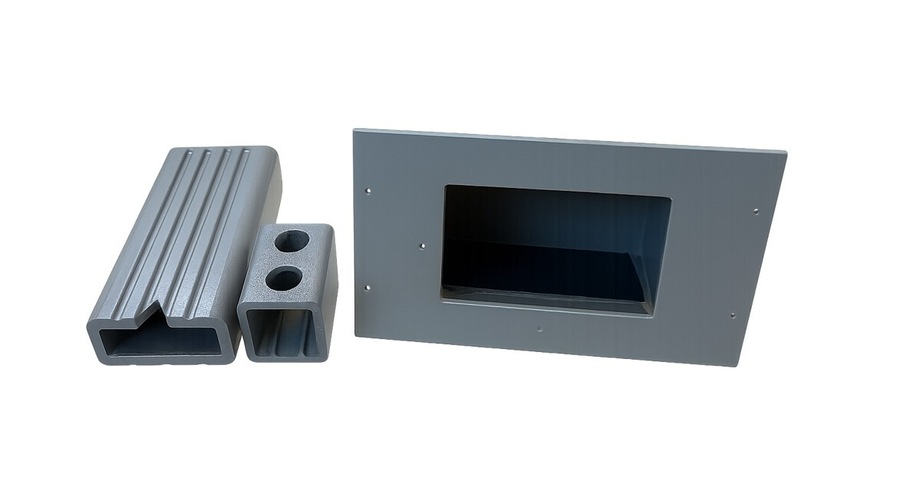
- Smart Expansion Grooves: Our elastomer pads are designed with longitudinal grooves (ribs). These grooves act as internal expansion chambers. When the staircase is loaded, the material does not lock up; instead, it expands controllably into the grooves, maintaining full elasticity.
- Optimal Bearing Area: Acoustic science dictates that for optimal sound insulation, a bearing area of 200 to 250 mm² per kN of ultimate load is required. Our heavy-duty TSS 102 connector, for instance, features a total bearing area of 25 000 mm² paired with an ultimate load rating of 100 kN. This delivers exactly 250 mm²/kN - achieving the absolute acoustic ideal factor.
Test Results by Product Configuration:
The laboratory testing at STEP GmbH evaluated how different telescopic units performed when paired with recess formers cast into the wall:
- IC TSS 60P + IC Box 100 SRU: Recorded an outstanding impact sound level between 34.8 dB and 45.2 dB (depending on the total dead load of the landing). This configuration represents our high-performance acoustic solution.
- IC TSS 101 + IC Box 100 SRU: Delivered highly impressive metrics ranging from 35.1 dB to 42.8 dB across variable loading intervals.
- IC TSS 102 + IC Box 100 (Without SRU damper): Even without the supplementary acoustic element inside the recess former, the assembly clocked in at a rock-solid 43.6 dB to 47.1 dB. This remains comfortably below the strictest Scandinavian limits of 52–53 dB.
Technical Note for Structural Engineers (RIB):
The laboratory data demonstrates that our SRU recess former (IC Box 100 SRU) provides the best sound attenuation on the market. While the vertical rubber flange operates as an independent system to mechanically seal the joint gap, it is the systematic combination of our elastomer - equipped TSS units and SRU wall boxes that yields the most advanced acoustic performance.
Documented Acoustics
By specifying staircase connections from Invisible Connections, you select a structural solution rigorously tested and certified under tomorrow's European framework (EN 17823). You gain fully documented, passive impact sound insulation that keeps residents satisfied and the indoor environment silent - decade after decade.
The future of construction demands verified, data-driven acoustics, and we have already engineered the solution for you.
Contact us: